
From gym bros to everyday protein pursuers: Chobani taps Aussie penchant for protein as high-protein yoghurts cracked 40 per cent household penetration
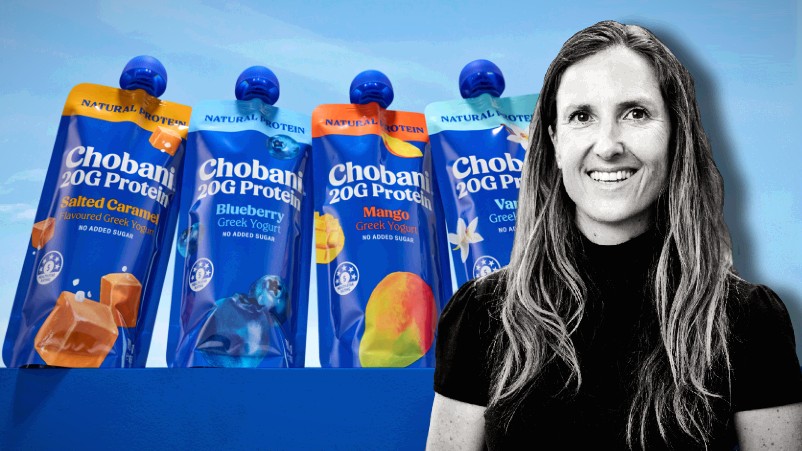
Chobani is ditching the disruptive innovation distractions – and even plant-based opportunities like oat milk – to instead double down on its core product: Authentic, strained, fresh milk-based yoghurt. And thanks to the broadening, diversifying pool of consumers pursuing ever-greater levels of protein, growth prospects are good. According to the latest Circana data, 40 per cent of total sales nationally in the last year, to 97 per cent of Australian households buying yoghurt, were high-protein products. Cue Chobani’s latest debut: A 20g product, its VP of marketing, Ellie Vince, says will appeal not just to the “gym bros”, but also the mums and dads watching kids on the sidelines of the soccer field every Saturday. Consumer choice is key, says the marketing leader, but it’s clarity and commercial aptitude that will be key to securing it.
What You Need to Know
- Australia’s yoghurt category is booming, up 12.7% year-on-year, with growth accelerating in the last quarter, per Circana data.
- High-protein yoghurt is the standout, growing at roughly double the rate of the total category: Chobani hold about 20% of the high-protein segment, but it’s now going for more with the launch of Chobani 20G, delivering 20 grams of protein in a fresh milk product.
- Chobani VP of marketing, Ellie Vince, notes demand for high-protein products has broadened beyond fitness enthusiasts to mainstream consumers across multiple demographics and occasions.
- The launch also marks a return to focusing on its core yoghurt range, exiting distractions like oat milk to prioritise high-protein innovation and shifting away from a cross-functional growth team pursuing category-busting innovation.
- In line with broader consumer consumption and its focus on choice and accessibility rather than specific demos, Chobani’s local marketing strategy has broadened: Sampling for example, has gone from niche health channels to mass reach, including sports events, families and workplaces.
- In addition, the media mix leans on out-of-home, radio education campaigns, and brand-led experiential “Chobani magic” activations.
- For Vince, success metrics focus on a commercial “trifecta”: Driving demand and profit, expanding the category, and strengthening brand salience and penetration.
Australia’s ever-greater penchant for protein has seen the breadth and diversity within the yoghurt category absolutely boom over the last few years. According to Circana scan data, the category is up 12.7 per cent over the last 52 weeks ending 22 March 2026, accelerating even further over the previous quarter.
What’s interesting, however, is that it’s high-protein that’s now become the darling within the product mix, blitzing it at twice the growth rate of total yoghurt category sales in the last year. It’s a growth line ratcheted up by a broadening consumer base extending from gym bros and workout bunnies to multiple demos and occasions, on and off the field.
That’s fabulous news for Chobani, which has spent the last 18 months ditching the distractions – oat milk, for example – to double down on iterating its core yoghurt product line. The latest in the line-up: A 20g authentic strained Greek Yoghurt. Launched in March, Chobani 20G delivers 20 grams of natural protein per serve, and is made from 100 per cent fresh milk.
Over the last quarter, Chobani’s high-protein products (12g, 15g in multiple formats) drove 20 per cent of that total high-protein yoghurt segment, per Circana Grocery scan data. Now, with another high-protein offering in play, the local marketing team is endeavouring to work the “Chobani magic” and build mainstream preference in what’s fast becoming a crowded market by embracing broader sampling occasions, out-of-home and reach-based media, and providing choice.
“One of the other things we look at is household penetration – that’s really key in terms of growing the Chobani brand, but we also look at household penetration of different segments,” Chobani VP of marketing, Ellie Vince, tells Mi3. “If we look at the total yoghurt category, almost everybody buys yoghurt on an annual basis – total yoghurt household penetration is 97 per cent.
“But when we break that down and look at the high-protein yoghurt segment, we can see about 40 per cent of households in the last 52 weeks have bought into high-protein yoghurt. What that shows is, despite the fact we’re getting significant growth within the market, at 40 per cent, there’s still a significant amount of headroom for further growth.”
Culling the disruptive innovation distractions
Focusing on core product line iteration is the manifestation of changes made 18 months ago by the then newly installed Chobani ANZ MD, Scott Hadley. For four years prior, Chobani had gone hard on category-busting innovation, appointing a GM of growth (specialist and cross-functional growth and innovation division) and GM of demand (covering marketing, sales and category) to disrupt the business and accelerate the new.
Hadley dismantled this function upon his arrival in July 2024 in favour of reinstalling a GM of marketing role, as well as a GM of science and innovation, plus GM of sales. Vince is the GM of marketing. At the time, Hadley told Mi3 he was looking to improve growth at both ends of the balance sheet, growing market reach by expanding into more channels, as well as running the business more “effectively and efficiently” through innovating within the core product portfolio while bolstering brand awareness and consideration.
“One of the things Scott was definitely keen on when I came in 18 months ago, was how do we just maximise our base business? And how do we just do the foundations really, really well?” Vince tells Mi3. “We could get ahead of ourselves, and we know that in most businesses, there are 100 things you can do. That’s particularly true of Chobani Australia at the moment: There is no shortage of opportunities, particularly within the yoghurt category, where we’re getting such significant growth.
“But the more important thing for us is how do we just get the basics right: How do we maximise the potential in yoghurt in the moment and the Chobani brand? There’s so much more room for growth in just doing that before we would even think further ahead or about longer-term opportunities.”
And right now, that opportunity is protein uplift. Per Vince, the growth rate and household penetration of high protein were a lot lower just two years ago and narrowly focused.
“It was – if you excuse the term – the domain of gym bros or the pre and post gym or workout recovery. And the format mainly was around convenience, so whether that was a pouch or a pot, but it was specifically for on the go, on my way to a workout, or on my way home from a workout,” she explains. “What we’ve definitely seen change within the last 12 months is that protein has moved more mainstream, and it now serves multiple needs. Rather than just this recovery need, we’re seeing it pop up across things like muscle maintenance; the over-40s are being served up a lot of content around muscle maintenance. It’s also delivering against this need for satiety, keeping me full throughout the day, plus energy.
“Because of that, it’s opened up protein to multiple demographics. Beyond people really into health and wellness, we’re seeing active teens, busy families, female focus, retirees and empty nesters – protein is becoming more a part of everybody’s everyday lifestyle. That’s now what’s driving that increase in household penetration, and will continue to grow that penetration.”
High protein is usefully core to Chobani’s overarching brand story: Making nutritious food more accessible and not compromising between taste and health. “Our products have always been made in a particular way where they are authentically strained. What that means is we concentrate the protein, which delivers a resulting product that is naturally thick, creamy, delicious, but also naturally high in protein,” continues Vince.
“The launch of Chobani 20G is really about offering more consumer choice … It means we can stay true to our brand philosophy, which is around simple ingredients, really high-quality products that taste delicious.”

Ellie Vince, VP marketing, Chobani
Ditching the plants for milk-based proteins
Getting the basics right has caused rationalisation – even if that means exiting other notably growing categories. Prior to Vince’s arrival, Chobani had just over 80 SKUs in the local market.
“The hardest decisions as a marketer, or even from a total business point of view, that you need to make, is whether I put my resource and effort over here into A, or if I put my resource and effort into B,” agrees Vince. “It’s about how you maximise the commercial return for the business in everything that you do. That means we are constantly assessing our total portfolio to understand whether it is delivering the best mix for us.
“There’s definitely been some challenging decisions along the way … We got out of a couple of segments that were not serving us, such as oat milk. The business had got into it for the right reasons at the time – it aligned with consumer trends, and the way we executed that was true from a brand point of view. But it added complexity, and it wasn’t the best use of time, effort, resource to deliver maximum return and impact.”
Mainstream reach
Serving the 97 per cent of households already buying yoghurt in the weekly shop nevertheless means Chobani is pursuing a very broad market. Vince positions it less about choosing demos and again, more about choice and accessibility.
“Chobani is a brand that has already been bought across multiple demographics, and we can see that within our data – we span multiple household structures,” she says. “A couple of years ago, when we first launched our 15 gram product, you could see there was a skew to a slightly younger consumer, which probably aligned more with that early uptake and the onslaught of the health and wellness trend. But now we are about just offering choice. And choice comes through multiple pack formats; it comes through different protein grammage levels and price points.
“So we don’t go tight [on demos], we don’t go on being about men who are into building muscle, etc, we are a product that is accessible. This also plays back to the core purpose of Chobani: Good food for all. It’s the philosophy we live and breathe internally here, and it shows up in everything that we do.”
This is also reflected in the team’s marketing strategy and execution. “We are much broader in our execution than where we would have been previously,” continues Vince.
A core part of Chobani’s go-to-market has always been sampling and getting product into people’s hands and mouths. “Go back maybe two years ago, and sampling would have been more targeted towards health and wellness spaces – such as gyms, Pilates studios, yoga, and so on. With the broadening of high protein from a demographic point of view, and it now delivering to multiple needs and occasions, our sampling is not targeted towards specifically health and wellness options,” says Vince.
“Our sampling is now also getting to sports grounds where kids are playing soccer or footy in the mornings, and sampling to busy parents that need to get through that morning space and maybe haven’t had a chance to have brekkie or are trying to fill that gap between that and lunch. It is also showing up in places like the Melbourne marathon, which we’ve been doing for the last couple of years… But it’s just as much about those competing within sports as it is about those spectating.”
A fresh three-week activation from 13 April sees Chobani running a pop-up café in Melbourne CBD “to bring a bit of joy and Chobani magic into the city” by sampling free brekkies from across the whole Chobani range.
In media, meanwhile, execution is driven less by channel and more by the outcome of what Chobani’s trying to achieve. A specific media campaign for 20G is due later this year.
“We do buy quite a lot of out-of-home media, particularly from a visual point of view and if we’ve got something new to market,” says Vince. “We have a radio campaign we’ve been running recently, which is more an educational campaign talking about the role of protein within people’s lives.
“But we also balance that out with this Chobani magic, which was how the brand really established itself. That was balancing that broad-reaching messaging with being disruptive, being distinctive and being memorable in the market.”
Cue the Cho Van and a Cho team going about surprising and delighting consumers with product and merch. “We’ve broadened that program out a little bit now so it turns up at businesses and workplaces. It turns up to surprise and delight healthcare practitioners, whether that’s at hospitals or dietitians and nutritionists, because we have such a fan base in healthcare practices. It turns up at sporting clubs,” says Vince. “That direct end user engagement is still really, really important to us.”
Ellie Vince, VP marketing, Chobani
Measuring success
With household penetration so high, it’s consumption growth within the yoghurt category that’s the key here.
“It’s things like high protein that are giving people another reason to pick up yoghurt. They might have multiple brands or multiple yoghurt segments within their fridge, and they’re delivering against different needs and occasions throughout the day,” says Vince.
Metrics helping the marketing team hold focus is a “trifecta of a positive commercial impact to our business”, adds Vince. “Are we driving consumer demand, which is resulting in profitable growth from our business point of view? Are we seeing category expansion, and are we seeing share growth within that? And then are we strengthening the brand, are we seeing penetration growth and salience growth? And from a salience point of view, are we showing up, or are we being memorable in the moments that matter from a consumer point of view?
“A great example for us is that breakfast is such a key occasion. How salient Chobani is within the breakfast occasion is a really important indicator for us.”
To stick to the goal, Vince says her big thing as a marketing leader is to bring clarity to the team and business. “That’s clarity of where we’re going, and clarity of what is going to drive the growth and have the biggest impact on our business category,” she says. “There are so many opportunities at the moment, and with that comes greater skill and courage to decide what you’re not going to do.
“I know that was very aligned with Scott’s plans when he came in. It was about getting back to knowing what we do really well … There was loads of great work going on in the business, but it was how do we get real clarity over the biggest opportunities, what our big bets could be internally, then line up all the teams behind that. That’s really what has driven everything lining up behind 20G. Hopefully we’ll see that be a huge success in the market. There’s loads more to come as well. There’s so much opportunity for Chobani in the future.”